Milk Crumb: The Hidden Science Behind Extraordinary Milk Chocolate
Why the way we process milk may matter as much as the milk itself.
Imagine two milk chocolates made with almost the same ingredients.
One tastes sweet, milky and familiar. The other carries notes of caramel, warm toffee and slowly cooked milk. Its flavour feels deeper, more rounded and surprisingly complex.
What changed?
Not necessarily the ingredients. It may be the way they were brought together.
This is where milk crumb enters the story a fascinating, often overlooked ingredient in chocolate manufacturing.
1. Milk crumb is not just an ingredient. It is a flavour-building process.
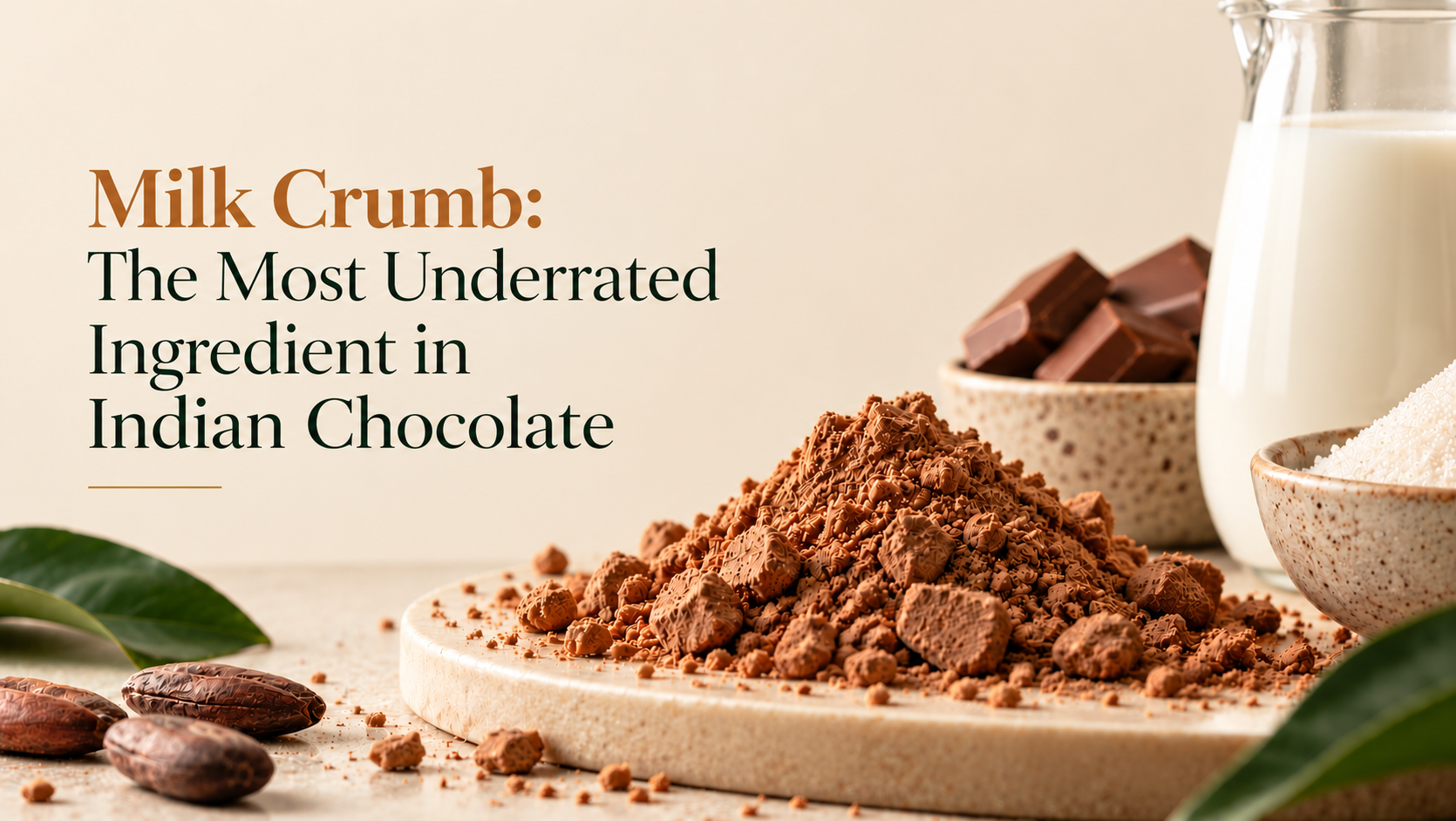
Milk crumb is a dried mixture of milk, sugar and cocoa ingredients used in the manufacture of milk chocolate.
But its real significance lies in how it is made.
In conventional milk chocolate, milk powder, sugar and cocoa ingredients are generally brought together during chocolate manufacture. In the traditional crumb process, milk, sugar and cocoa undergo processing together before the crumb is dried and used to make chocolate.
That difference changes the chemistry of the ingredients and creates a distinctive flavour that ordinary dry mixing cannot fully reproduce.
The insight: In chocolate making, ingredients do not simply contribute their individual flavours. They can also create entirely new flavours when processed together.
2. The science behind that caramel-like flavour
The key player is the Maillard reaction.
Think of the aroma of toasted bread, the flavour of cooked milk or the rich notes of a well-made milk toffee. These familiar experiences involve complex chemical changes during heating.
In milk crumb, lactose -the natural sugar in milk reacts with amino compounds from milk proteins under suitable processing conditions. This produces a range of flavour and aroma compounds.
The result can include cooked-milk, toasted, caramel-like and other complex notes. The exact profile depends on the formulation and processing conditions.
Here is a distinction worth remembering:
Maillard reaction is not the same as caramelisation.
Caramelisation involves the thermal breakdown and transformation of sugars. The Maillard reaction involves reducing sugars reacting with amino compounds. Both can contribute to flavour development, but they are different chemical pathways.
Milk crumb's characteristic flavour is strongly associated with Maillard chemistry.
The objective is not to cook the ingredients as much as possible. It is to develop the right flavour without creating burnt, harsh or unwanted notes.
3. Why does this matter to a chocolate maker?
Because sweetness and flavour are not the same thing.
Adding more sugar makes a chocolate sweeter. Adding a flavouring may introduce a specific note. But controlled processing can create a broader spectrum of flavours within the ingredient system itself.
Milk crumb offers three interesting possibilities:
- Flavour depth: Develop more complex cooked-dairy and toffee-like notes.
- A distinctive identity: Create a milk chocolate whose character comes partly from its manufacturing process.
- New product directions: Explore how developed dairy flavours interact with different cocoa profiles.
For Indian chocolate makers, this opens an intriguing avenue of experimentation.
Our food culture already appreciates the flavours of khoa, peda, rabri and milk toffee. Could crumb-based chocolate explore a similar flavour vocabulary while retaining its own identity as chocolate?
That is a worthwhile research question not a guaranteed consumer preference.
4. Can milk crumb make better chocolate?
Potentially, but we need to define better.
Milk crumb can help develop a distinctive flavour profile. It does not automatically guarantee smoother texture, better melting, lower sugar content or a superior finished product.
Those properties also depend on formulation, particle size, fat content, moisture, refining, conching and tempering.
Nor should milk crumb be confused with simply heating milk powder and sugar together. Similar flavours may develop through alternative approaches, but the resulting ingredients are not necessarily equivalent in composition or performance.
For a chocolate maker, the real question is not whether milk crumb is inherently superior.
It is whether the process creates a flavour and texture worth pursuing in a particular chocolate.
5. A simple experiment for the curious chocolate maker
If you want to understand milk crumb, do not begin by asking whether it is fashionable. Begin with a controlled comparison.
Taste a conventional milk chocolate alongside a crumb-based chocolate, ideally with comparable cocoa, sugar, fat and milk-solids levels.
Evaluate them blind.
Look beyond the first impression of sweetness. Ask yourself:
- Does one have a deeper cooked-milk character?
- Are the caramel and toffee notes more pronounced?
- Does the cocoa remain identifiable?
- Is the finish pleasant, or does it become overly cooked?
- Which chocolate has the flavour balance you actually want?
This is how an interesting ingredient becomes a useful product-development tool: through observation, comparison and evidence.
The bigger lesson
Chocolate flavour is not determined by ingredients alone.
Cocoa fermentation, roasting, milk processing, refining and conching can all influence the final sensory experience. Milk crumb offers another example of how processing can transform familiar raw materials into something different.
For Indian chocolate makers, its greatest value may lie not in copying an established manufacturing tradition, but in understanding the science well enough to explore new possibilities.
Sometimes, innovation does not begin with an exotic ingredient.
Sometimes, it begins by asking a better question about the ingredients we already know.
And milk crumb leaves us with exactly that question: What other flavours are hiding in familiar ingredients, waiting for the right process to reveal them?
A question for chocolate makers
If you were developing your next milk chocolate, what would you explore first?
A. A more distinctive cocoa profile
B. Deeper dairy and caramel notes through processing
C. A different balance of sweetness, fat and texture
At RT Chocos, we believe understanding the science behind chocolate is the first step towards making more thoughtful, distinctive products.
Explore the ingredient. Understand the process. Question the familiar.

Leave a comment
Share your thoughts, questions, or experience with this chocolate science topic.