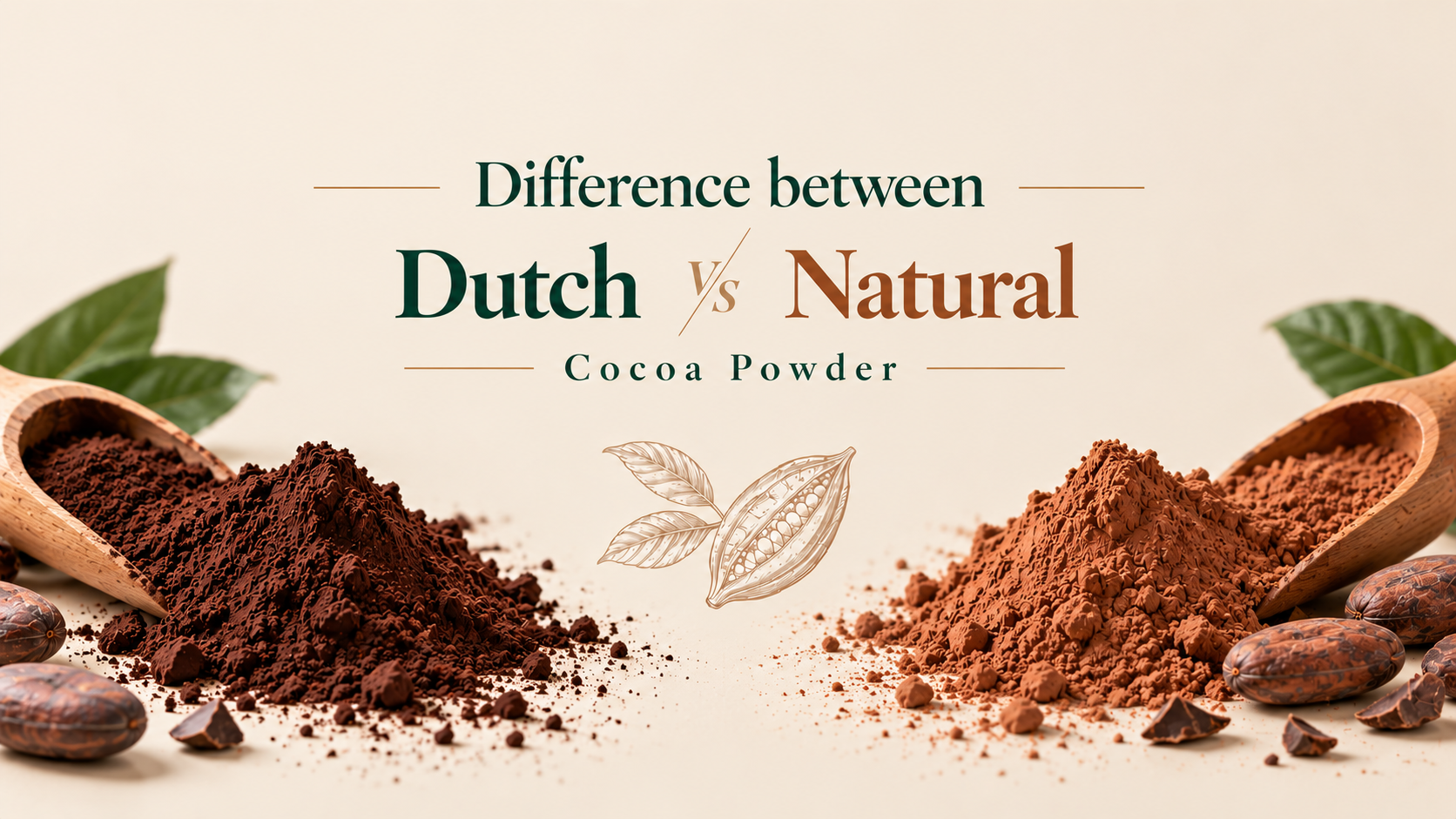
Not all cocoa powders behave the same way.
Two cocoa powders may both be labelled simply "cocoa powder", yet one may be lighter and more acidic, while the other is deep brown, smoother and much less acidic. One may work beautifully in a cake, while the other performs better in a dark coating or beverage.
The reason is processing.
The most important difference between natural cocoa powder and Dutch-process cocoa powder is alkalization, a treatment that changes the cocoa’s pH and, along the way, its colour, flavour, composition and functional behaviour.
Understanding this difference is important not only for bakers and chocolatiers, but for anyone developing chocolate, bakery, beverage, confectionery or dairy products.
What Is Natural Cocoa Powder?
Think of natural cocoa powder as cocoa in its most straightforward form. Cocoa beans are fermented, dried, roasted, and cracked open to get the inner nibs. Those nibs are ground into a thick paste called cocoa liquor, which is then pressed hard to squeeze out most of the fat (cocoa butter). What is left behind is a dry cake, which gets crushed into the fine powder we know as cocoa. No chemicals are added to change its character — what you get is essentially what the bean, the fermentation, and the roast gave you.
Because fermentation naturally produces acids — mainly acetic acid (the same acid in vinegar) and citric acid (the same acid in lemons) — natural cocoa powder is inherently acidic. Its pH typically falls somewhere between 5.0 and 5.8, though this varies depending on where the beans were grown, how they were fermented, and how they were roasted.
In terms of taste and appearance, natural cocoa is lighter in colour — ranging from tan to warm reddish-brown — with a flavour that leans sharp, bright, sometimes fruity, slightly mouth-drying, and distinctly "cocoa-forward."
What Is Dutch-Process Cocoa Powder?
Dutch-process cocoa — also called alkalized cocoa — has been treated with an alkalising agent, most commonly potassium carbonate, though sodium carbonate, sodium hydroxide, and ammonium carbonate are also used in industry. The process was pioneered in the early 19th century by Coenraad Johannes van Houten in the Netherlands, hence the name.
Alkalization can be applied at different stages: to the cocoa nibs before grinding, to the cocoa liquor, or to the pressed cocoa cake. Each approach produces somewhat different results, and experienced cocoa processors choose the stage and intensity carefully to achieve a target colour, flavour, and pH.
The resulting powder typically has a pH in the range of about 6.8 to 8.1, depending on how aggressively the process is applied. Industry practice often classifies alkalized cocoa into light (roughly pH 6.5–7.2), medium (roughly pH 7.2–7.6), and heavy (pH above 7.6) alkalization levels.
The colour deepens. The flavour softens. The chemistry changes in ways that ripple through every application.
What Actually Happens During Alkalization?
Alkalization is not a single change; it triggers a cascade of chemical shifts all at once. Here is what is happening inside that cocoa:
- The sharp acids get neutralised: Remember the vinegar-like and citrus-like acids from fermentation? The alkaline solution cancels them out, partially or almost entirely, depending on how much is used. This is why Dutch cocoa tastes less sharp.
- The natural antioxidants transform: Cocoa is rich in compounds called flavanols — the same family of antioxidants that gets tea and red wine their health headlines. Alkalization changes some of the natural compounds in cocoa, especially polyphenols. During this process, these compounds are broken down and changed into new compounds, some of which contribute to the deeper brown and red-brown colours we see in alkalized cocoa.
- Browning reactions speed up: You know how bread crusts turn golden-brown in the oven? That is the Maillard reaction, a reaction between sugars and amino acids that creates colour and flavour. Alkaline conditions accelerate this reaction in cocoa, pushing it toward deeper browns and subtly shifting the taste.
- Aroma compounds fade or change: The fruity, bright, tangy scent notes that natural cocoa carries are partly lost during alkalization. The aroma becomes smoother, simpler and pleasant, but with fewer high notes.
- The physical structure of the powder changes: The alkaline treatment loosens the internal cell walls of cocoa particles, which changes how the powder absorbs water and interacts with fat. This is one reason Dutch cocoa can behave differently when you mix it into a drink or a batter.
The end result? A powder that is darker, mellower, less acidic, and functionally quite different from its natural counterpart — even though it started from the same bean.
Why Does Alkalized Cocoa Become Darker?
Alkalized cocoa becomes darker because the alkaline treatment changes the way cocoa’s natural colour compounds behave.
Natural cocoa is usually light to medium brown, sometimes with reddish tones. When an alkaline ingredient is added, it raises the cocoa’s pH and alters its phenolic compounds — the same family of compounds that contribute to cocoa’s colour, bitterness and astringency. As these compounds react and transform, the powder can move from reddish brown to deep brown, and eventually to the almost black colour associated with black cocoa.
The final colour depends on more than alkalization alone. The cocoa’s origin, fermentation, roasting conditions, type of alkali and strength of treatment all play a role. This is why two cocoa powders can both be labelled "Dutch-process" yet look and taste completely different.
For a chocolatier, the key point is simple:
Darkness is a specification, not a measure of quality.
A very dark cocoa may be exactly right for sandwich biscuits, dark cakes or products where strong visual contrast is important. But darker cocoa does not automatically mean deeper, richer or more complex chocolate flavour. Heavy alkalization can soften acidity and change the balance of aroma, bitterness and astringency.
So the darkest cocoa is not necessarily the best cocoa. It is simply cocoa that has undergone a more pronounced processing treatment — and the right choice depends on what you want the finished product to look and taste like.
The Real Difference Is Not Natural vs Dutch
Natural and Dutch-process cocoa are often presented as two interchangeable choices: one acidic and light, the other darker and less acidic. For anyone working seriously with cocoa, that description is far too narrow.
Alkalization is a deliberate processing decision that changes the chemical, sensory and functional identity of cocoa. It can alter acidity, colour, flavour and the way the powder behaves in a formulation. The significance of that change depends entirely on where the cocoa is going next — into a cake, a beverage, a filling, a compound coating or a chocolate system.
That is why experienced chocolate makers do not select cocoa by colour alone, or by the word Dutch on a specification sheet.
They define the product first, establish the required flavour, colour, acidity and processing behaviour, and then select the cocoa that delivers those parameters consistently.
Natural cocoa is not inherently better. Dutch-process cocoa is not inherently better. The better cocoa is the one that gives the formulation exactly what it needs without compromising the character of the finished product.


Leave a comment
Share your thoughts, questions, or experience with this chocolate science topic.