Cocoa Butter vs Vegetable Fat: What Really Changes Inside Chocolate?
The fat in chocolate is not merely an ingredient. It is the architecture holding the chocolate together.
Break a well-made chocolate. Listen to the snap. Let it sit on your tongue. Notice how quickly it melts, how cleanly it releases its aroma, and how little it leaves behind.
Much of that experience comes down to one ingredient: fat.
For centuries, that fat has been cocoa butter, the natural fat extracted from the cacao bean. Modern confectionery, however, also uses a range of vegetable fats designed to replace, partially replace, or complement cocoa butter.
At first glance, the two may appear interchangeable. They are not.
The real difference lies in molecular structure, crystallisation, melting behaviour and how the fat interacts with the other ingredients in chocolate.
First: What exactly is cocoa butter?
Cocoa butter is the natural fat of the cacao bean.
When cacao beans are fermented, dried, roasted and processed, the nibs are ground into cocoa mass. Pressing that mass separates much of the cocoa butter from the cocoa solids.
Chemically, cocoa butter is predominantly made of triacylglycerols - fat molecules built from glycerol and fatty acids. Three important ones are POP, POS and SOS:
- P = palmitic acid
- O = oleic acid
- S = stearic acid
Their particular arrangement gives cocoa butter an unusual ability to form highly organised crystals.
And this is where the magic of chocolate begins.
Chocolate is a crystal, not just a mixture
This is one of the most misunderstood aspects of chocolate making. When chocolate is melted, cocoa butter loses its existing crystal structure.
As it cools, the fat can crystallise in several different forms. Cocoa butter is known to exhibit six polymorphic forms, commonly referred to as Forms I–VI. They are not equally desirable.
For conventional chocolate manufacture, Form V is particularly important because it provides the combination of gloss, hardness, snap, contraction from the mould and a controlled melt that chocolatiers are looking for.
That is why we temper chocolate.
Tempering is not simply “cooling chocolate.” It is engineering the fat crystal structure. A good temper creates the right population of crystals so that the finished chocolate behaves the way we expect.
So where do vegetable fats enter?
“Vegetable fat” is actually a very broad term. It does not mean one single ingredient.
Depending on the application, confectionery manufacturers may use specially selected or modified fats derived from sources such as palm, palm kernel, shea, kokum, illipe or other vegetable sources.
Technologists classify these broadly as:
Cocoa Butter Equivalents — CBE
Fats designed to behave similarly to cocoa butter and, depending on the formulation and regulations, can be blended with it while maintaining much of chocolate's characteristic behaviour.
Cocoa Butter Replacers — CBR
Fats formulated to partially replace cocoa butter while retaining acceptable chocolate-like properties.
Cocoa Butter Substitutes — CBS
Fats that can replace cocoa butter more extensively and are commonly used in compound coatings and other applications.
The important point is this:
Not all vegetable fats behave like cocoa butter. Their fatty-acid and triacylglycerol composition determines their melting profile, crystallisation behaviour and compatibility with cocoa butter.
Cocoa Butter vs Vegetable Fat: The real difference
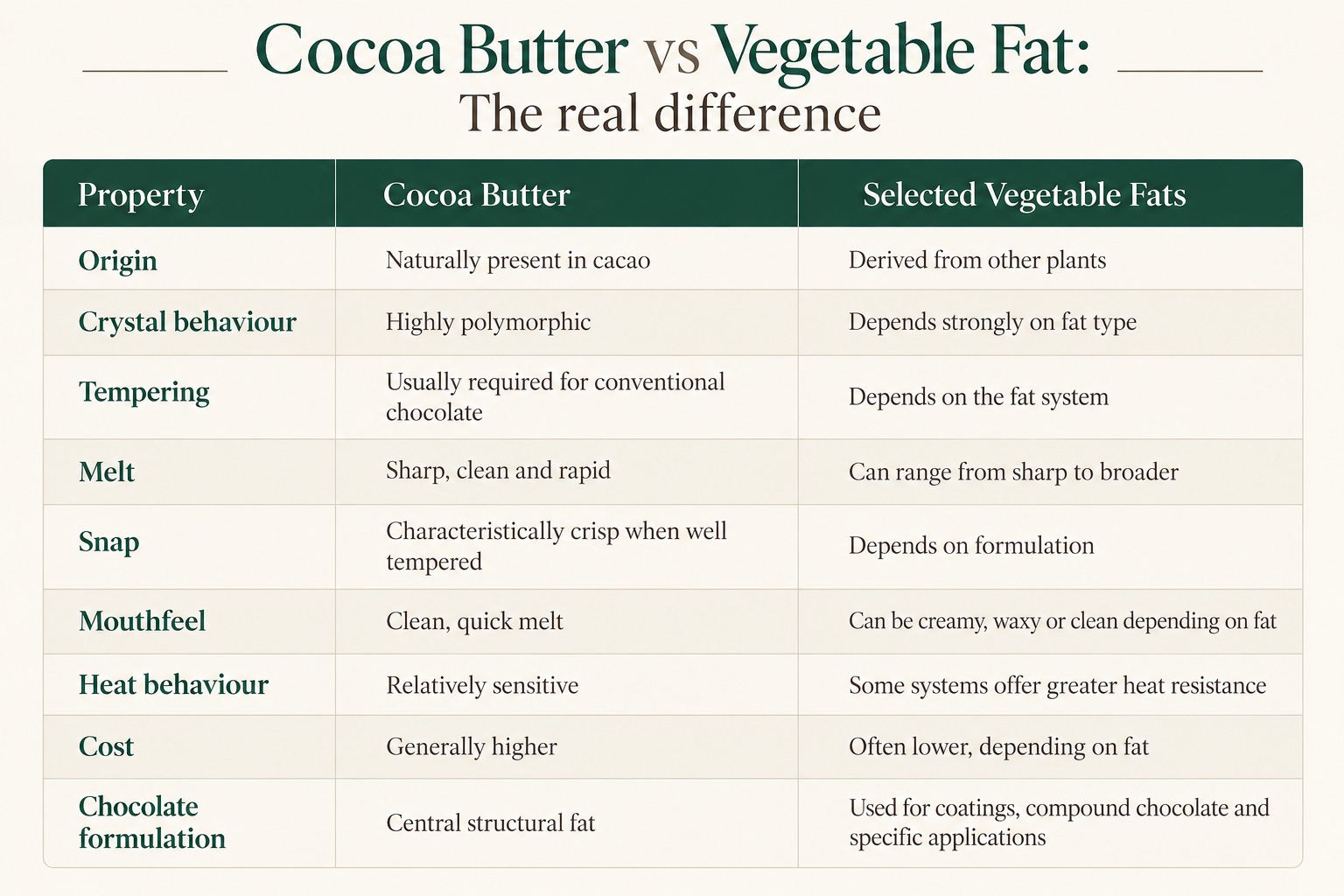
The table tells only half the story.
The fascinating part is what happens at the molecular level.
Why cocoa butter melts so beautifully
Cocoa butter has a relatively narrow melting transition. Well-crystallised cocoa butter-based chocolate can remain firm at room temperature but melt rapidly around body temperature.
That transition is a major reason chocolate can feel solid in your hand yet almost disappear in the mouth. This is not an accident. It is the result of cacao's particular fat composition and crystal structure.
Think of cocoa butter as a carefully tuned natural system:
firm → snap → warm → melt → release flavour
That sequence is part of the sensory identity of chocolate.
Vegetable fat changes the equation
A vegetable fat can be technically excellent and still behave differently from cocoa butter. Its melting curve may be broader. Its crystallisation may occur differently. Its interaction with cocoa butter may alter the final crystal network.
And depending on the fat, the mouthfeel can range from beautifully clean to noticeably waxy.
This is why simply asking:
“Is vegetable fat good or bad?”
is the wrong technical question.
The better question is:
“Which fat, at what level, in which formulation, for which application?”
A carefully engineered cocoa butter alternative can perform extremely well in the right product. A poorly selected fat can compromise texture, flavour release and stability.
But does cocoa butter automatically mean better chocolate?
Not necessarily. This is where chocolate conversations often become too simplistic.
A chocolate containing cocoa butter can still be poorly formulated, poorly refined, badly tempered or badly stored.
And a compound coating made with a well-designed vegetable-fat system can deliver excellent gloss, coating behaviour, snap and stability for its intended application.
The ingredient does not work alone.
Formulation + fat + particle size + refining + conching + tempering + cooling + storage all contribute to the final product.
A great chocolatier respects the entire system.
The R&D view: neither fat is simply “good” or “bad”
After decades of chocolate development, the most useful way to look at this question is not emotionally.
It is functionally.
Choose cocoa butter when you want:
- Authentic chocolate character
- Clean melt
- Classic snap
- Traditional tempering behaviour
- Premium sensory experience
Consider a suitable vegetable-fat system when you need:
- Process simplicity
- Specific heat resistance
- Coating performance
- Manufacturing efficiency
- Cost optimisation
- A product designed around compound-chocolate technology
And sometimes the answer is not either/or.
Modern chocolate technology has developed sophisticated fat systems that can be blended or engineered to achieve very specific physical properties.
The Takeaway: It’s About More Than Just Fat
At the heart of every chocolate is a carefully balanced system of fat, sugar, cocoa solids and structure.
The choice of fat influences far more than the ingredient label, it affects how chocolate sets, how it breaks, how it melts, how flavours are released and how it performs during production and storage.
Cocoa butter remains unique because its natural composition and crystallisation behaviour are exceptionally well suited to chocolate. When properly tempered, it creates the familiar gloss, snap and clean melt that define fine chocolate.
Vegetable fats, on the other hand, are not simply substitutes chosen to reduce cost. Different vegetable fats can be engineered for specific functions such as easier processing, greater heat stability, faster setting or consistent coating performance.
The key is understanding that not all vegetable fats behave the same way, and not every application demands the same fat system.
For a chocolate maker, therefore, the real question is not “Which fat is better?”
It is:
“Which fat is right for the chocolate I am trying to create?”
Because good chocolate is not made by choosing ingredients in isolation. It is made by understanding how those ingredients behave together from the molecular structure of the fat to the final moment when the chocolate melts on the tongue.
And that is where chocolate science becomes craftsmanship:
choosing the right fat, controlling its crystals and designing the final eating experience with intention.

Leave a comment
Share your thoughts, questions, or experience with this chocolate science topic.