
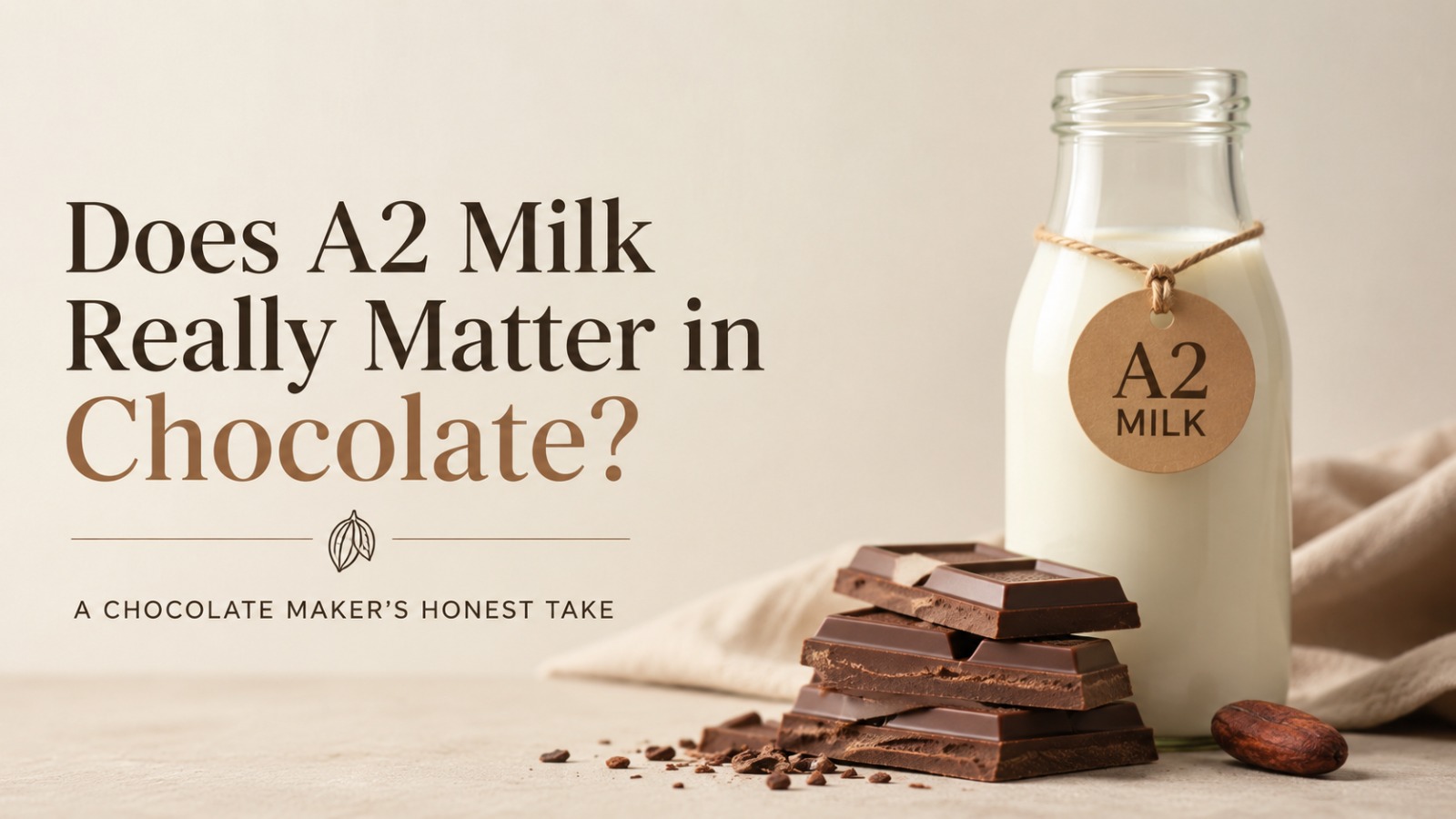
Does A2 Milk Really Matter in Chocolate?
A chocolate maker's honest take on the newest premium ingredient trend.
Walk into any chocolate expo today and you'll see a new star on the shelf A2 milk chocolate. In India especially, it's everywhere. Gir cow A2 chocolate. Desi A2 milk bars. Prices that are 30–50% higher than regular chocolate.
The big question is simple:
**Does A2 milk actually make chocolate better - or just more expensive?
What is A2 milk, really?
Cow's milk has a mix of proteins. One of the main proteins comes in two versions A1 and A2. Think of them as two slightly different flavors of the same protein.
- A1 is found in most Western cow breeds like Holstein and Friesian.
- A2 is more common in Jersey and Guernsey cows, and in many indigenous Indian breeds like Gir, Sahiwal, and Tharparkar but not every cow in these breeds automatically produces only A2 milk.
This is one of the most common misunderstandings in the industry. A chocolate brand cannot simply buy "Jersey milk" and call it A2. Genuine A2 milk comes from cows that have been individually DNA tested to confirm they carry two copies of the A2 gene. That test is what separates real A2 sourcing from loose breed-based claims.
The difference between A1 and A2 is very small just one tiny building block inside the protein is swapped. But that small swap changes what happens when your body digests it.
During digestion, enzymes can release a small peptide called beta-casomorphin-7 (BCM-7) from A1 beta-casein. Some studies suggest this peptide may contribute to digestive discomfort in certain individuals although the evidence remains mixed. A2 beta-casein does not release BCM-7 in the same way. That's it. That's the entire science behind the A2 story. Everything else the "healthier," "more natural," "ancestral" claims is built on top of this one small fact.
What actually matters when making milk chocolate?
Here's the truth from inside a chocolate factory. When we make milk chocolate, we don't lose sleep over A1 vs A2. We lose sleep over things like:
- How much fat is in the milk powder — richer milk means creamier chocolate.
- How fresh and dry the milk powder is — old or damp milk powder can ruin the flavor.
- How the milk sugar behaves when we heat and mix the batch.
- How well the milk mixes into the cocoa butter — this decides how smooth it feels on your tongue.
That caramel, cooked-milk flavor you love in milk chocolate? It comes from a slow cooking-and-mixing stage where milk sugars and milk proteins react together over hours. This reaction has almost nothing to do with A1 or A2. It has everything to do with heat, time, and the freshness of the milk.
So on the factory floor, A1 vs A2 changes almost nothing about how the chocolate flows, melts, sets, or tastes.
One thing most people don't realise: chocolate doesn't use fresh milk.
This is perhaps the most overlooked fact in the entire A2 debate. Most chocolate manufacturers from craft bars to global brands do not use fresh liquid milk. They use whole milk powder, skim milk powder, milk fat, or milk crumb, all of which are carefully standardised so that every batch behaves consistently.
Once milk is converted into a standardised dairy ingredient, factors such as fat level, moisture, freshness, and processing quality have a much greater influence on your chocolate than the A1/A2 protein variant itself. The protein remains A1 or A2 inside the powder that biology doesn't change. But from a chocolate-making perspective, it is simply outweighed by everything else.
**Here's the interesting part.
**Does A2 actually taste different?
There is currently no strong scientific evidence that A2 milk alone produces a consistently detectable flavour difference in chocolate when all other variables milk fat, powder quality, processing are held constant.
When people do notice a difference in chocolate made with A2 milk, the reason is almost never the A1/A2 protein itself. It is far more likely to come from the composition and quality of the dairy ingredient things like the milk fat content, the freshness of the milk powder, and how carefully it was processed. These are the variables that actually move the needle in a chocolate recipe.
**Is A2 chocolate actually healthier?
**Honest answer: probably not in any big, meaningful way. Here's why:
The health claim behind A2 is still being debated. European food safety experts reviewed the evidence and did not find a clear link between A1 milk and any disease.
Even if A1 milk does affect some people, a typical milk chocolate bar contains only a small fraction of the milk protein found in a glass of milk. So even if the effect is real, the dose from a bar of chocolate is far lower than from a glass of milk.
A2 does NOT help lactose-intolerant people. The milk sugar is exactly the same in both A1 and A2 milk. A2 does NOT help people with a milk allergy either. Milk allergies react to a completely different part of the milk.
If A2 provides a benefit, it is likely limited to a subset of consumers who tolerate lactose but may experience digestive symptoms associated with A1 beta-casein. For the majority of people, there is no evidence they would notice any difference at all.
So when does A2 make sense for a chocolate brand?
There are three genuinely good reasons a chocolate business might choose A2:
- It tells a great story. "Made with A2 milk from Gir cows" sounds premium,pure and traditional. Consumers love it. it's not a lie - it's smart positioning, and it works especially well in India.
- It comes with a more traceable supply chain. **A2 milk is often sourced through dedicated, carefully managed supply chains because getting genuine A2 certification requires genetic testing at the farm level. That traceability aligns well with premium chocolate brands that value knowing exactly where their ingredients come from.
- It signals ingredient intentionality. **Choosing A2 milk powder signals to buyers and retailers that you've thought carefully about every ingredient in your recipe. In a crowded premium market, that kind of visible care matters even when the functional difference is small.
The verdict A2 milk in chocolate is a big marketing story built on a small piece of science.
The science is real but modest one small protein swap, one possible digestive benefit for a small group of people. The marketing is much bigger than the science actually supports.
If you're a chocolate maker, the honest advice is this: don't switch to A2 thinking it will automatically make better chocolate. The protein variant alone won't do that. Switch to it because:
- It lets you tell a premium, credible story to the right customer, and
- The traceability and certification that comes with genuine A2 sourcing is itself a mark of quality.
What actually makes great milk chocolate is still what it has always been:
- Fresh, rich, dry milk powder
- Sourcing you can trust
- Careful, patient mixing to build deep flavor
- Honest labels
A2 is a nice line on the wrapper. But great milk chocolate is still made the old-fashioned way with great milk, great cocoa, and great craftsmanship.****
** The molecule is not the story. The craft is.

Leave a comment
Share your thoughts, questions, or experience with this chocolate science topic.