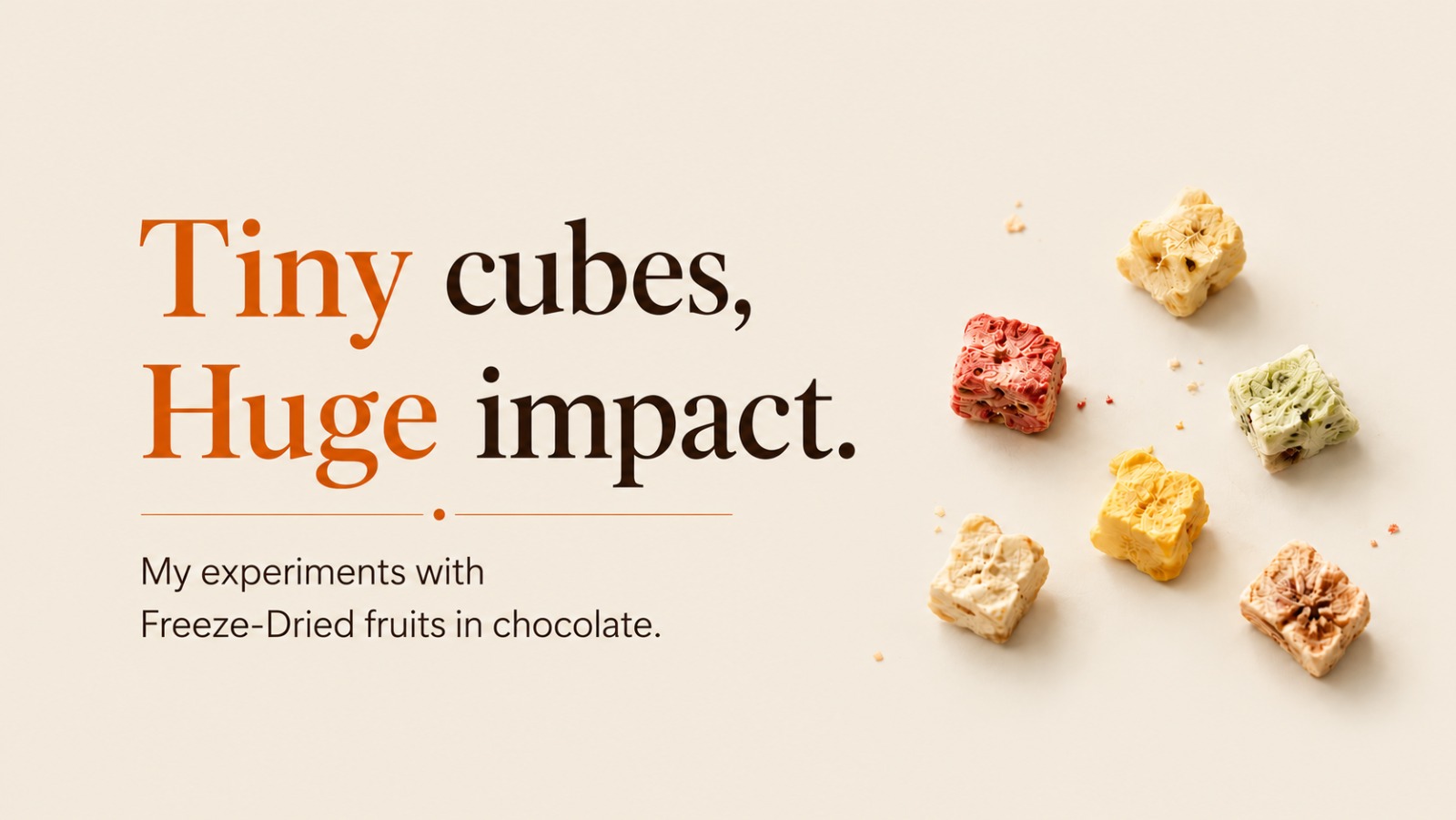
How This Started I recently received samples of freeze-dried fruit cubes in six varieties — Chikoo (Sapota), Guava, Pineapple, Jackfruit, Banana, and Strawberry. Rather than simply tasting them, I decided to evaluate each one across real chocolate applications: moulded bars, bonbons, and enrobed chocolates. I also pre-coated every cube in cocoa butter before use — a deliberate step to protect crunchiness inside the chocolate system. This article shares what I observed, what worked, and what challenges you should know about before working with these ingredients.
First Impressions: What You Notice Immediately
The first thing that strikes you is the colour. These cubes are far more vivid than any conventionally dried fruit — the strawberry is a deep, saturated red, the guava retains its pink blush, and the pineapple holds a clean golden tone without any browning. This colour preservation is not just visual appeal. It tells you that the drying process has kept the fruit’s natural chemistry largely intact.
The aroma is equally telling. Freeze-dried guava smells sharp, green, and genuinely like fresh guava — not the flat, muted note you get from sun-dried or oven-dried fruit. Pineapple carries its bright, sweet-acidic character. These aromas survive because the fruit was never exposed to the kind of aggressive heat used in conventional drying. For a chocolate maker, this matters enormously, because aroma is a huge part of how we perceive flavour.
The texture is crisp and light. The cubes shatter cleanly under pressure, almost dissolving on the tongue. They feel nearly weightless — a sign that almost all the moisture has been removed while the fruit’s internal structure remains intact.
Why Freeze-Drying Is Fundamentally Different
In regular drying, hot air evaporates the water at high temperatures. This works, but the intense heat damages flavour compounds, browns the sugars, collapses the fruit’s cell structure, and leaves you with something chewy and muted. The dried fruit you get is a distant version of the original.
Freeze-drying takes a completely different approach. The fruit is first frozen solid, then placed under deep vacuum. Gentle, controlled heat is then applied — just enough to provide the energy needed for the frozen ice inside the fruit to turn directly into vapour, skipping the liquid stage entirely. This process is called sublimation. The temperatures involved are far lower than in conventional drying, and no liquid water phase ever exists during the process. That is the critical difference. Because the heat is gentle and carefully managed, the fruit keeps its shape, its colour, its aroma compounds, and its natural flavour. The final product has very low moisture (water activity typically below 0.25), a porous crisp structure, and concentrated flavour that tastes remarkably close to fresh fruit.
Inside chocolate, this combination is powerful. The low moisture means the inclusion will not disrupt the chocolate. The crisp texture creates a satisfying crunch that contrasts with chocolate’s smooth melt. And the concentrated flavour delivers a genuine fruit experience — not a hint, but a clear, recognisable burst.
A Critical Step: Pre-Coating with Cocoa Butter
Before using any freeze-dried cube in my chocolate trials, I coated each piece with a thin layer of cocoa butter. This was not an afterthought — it was a deliberate technical decision based on how these ingredients behave inside chocolate systems.
Freeze-dried fruit is extremely porous. That porosity gives it the crisp, light texture we value, but it also makes the fruit highly vulnerable to moisture. When an uncoated cube comes in contact with warm chocolate during moulding or enrobing, or sits near a moist ganache in a bonbon, it can begin absorbing moisture almost immediately. The cocoa butter pre-coat acts as a thin, food-grade moisture barrier that seals the porous surface. It slows down moisture migration significantly, buys valuable time during processing, and helps the inclusion retain its crunch over the product’s shelf life.
The coating also improves how the cubes bond with the surrounding chocolate. An uncoated, porous surface can trap tiny air pockets at the interface, which weakens adhesion and can cause visible gaps when a bar is snapped. A thin cocoa butter layer creates a smoother fat-to-fat contact between the inclusion and the chocolate matrix, resulting in a clean break, better visual cross-section, and a more professional finished product.
I would strongly recommend this step to any chocolatier or product developer working with freeze-dried inclusions. It is simple, inexpensive, and makes a measurable difference to both crunchiness retention and product appearance.
What I Found Across Chocolate Applications
Moulded Bars were the easiest format to work with. The cocoa butter-coated cubes distributed well in the mould, and when bars were snapped, the colourful fruit fragments in the cross-section looked immediately premium. Pineapple and Strawberry performed best here — their acidity cut through the sweetness of milk chocolate and created a genuine flavour conversation. The crunch added a textural layer that plain chocolate simply cannot offer on its own.
Bonbons were more demanding, but also where I got some of the most interesting results. The approach I took was to place the cocoa butter-coated freeze-dried cube in the centre of the bonbon on its own — without any ganache surrounding it. This gave the consumer a direct, immediate crunch the moment they bit through the chocolate shell, which is a sensory experience most bonbons simply do not offer. Equally important, removing the ganache from the equation eliminates the biggest moisture risk entirely. There is no wet filling to drive moisture into the fruit, and the chocolate shell combined with the cocoa butter pre-coat provides a strong double barrier against external humidity. For makers who still want a ganache element alongside the fruit, I would suggest formulating it with anhydrous milk fat instead of cream. Anhydrous milk fat carries virtually no free water, so the risk of moisture migration into the freeze-dried inclusion is reduced dramatically. This opens up the possibility of a bonbon that delivers both a creamy ganache layer and a crunchy fruit centre — a combination that is rare and genuinely premium.
Enrobed Chocolates were the format where everything I know about moisture management got tested at once. The concept is simple — take a cocoa butter-coated freeze-dried fruit cube and run it through an enrober so it gets fully covered in tempered chocolate. But the execution demands precision. The chocolate coating is your primary defence against humidity, and its quality determines whether the product works or fails. Two things matter most: thickness and temper. A coating that is too thin — below roughly 1.5 mm — will not hold up under Indian humidity conditions. A coating that is poorly tempered will develop bloom and micro-cracks over time, and those tiny fractures become open doors for moisture. When done correctly, however, the result is outstanding. The consumer bites through a clean, well-tempered chocolate shell, hits a concentrated burst of fruit flavour, and gets a crisp, satisfying crunch — all in one bite. Among all my trials, Guava enrobed in 65–70% dark chocolate stood out as the strongest pairing. Its sharp, slightly bitter green character worked beautifully with the tannins in dark couverture, creating a flavour combination that felt sophisticated rather than sweet.
The inclusion only elevates the product when the system around it — formulation, process, packaging — is designed to protect it.
Why Freeze-Dried Fruits Premiumise Chocolate
The effect is multi-dimensional. You get crunch in a product category where texture is usually uniform. You get vivid colour fragments that make a bar look handcrafted and intentional. You get concentrated real fruit flavour — not a flavouring, not a paste, but actual fruit. And you get a story to tell: real Allahabad guava, real Chikoo from the Konkan, freeze-dried to preserve everything that makes the fruit special.
A plain moulded chocolate bar and the same bar with well-placed freeze-dried strawberry are not perceived as the same product by the consumer. The inclusion moves the product from everyday to gift-worthy. But this perception only holds if the fruit is still crisp and flavourful when the consumer bites into it. A soft, stale inclusion communicates the opposite of premium — which is exactly why steps like cocoa butter pre-coating and proper barrier packaging are not optional extras. They are what make premiumisation real rather than just a label claim.
The Challenges You Must Understand
This is where many product developers stumble, so I want to be direct.
Moisture is the enemy. Freeze-dried fruit is hygroscopic — it absorbs moisture from the air rapidly. In Indian conditions, where humidity regularly exceeds 65–75%, an exposed cube can lose its crispness within an hour. Once the moisture is absorbed, the crisp texture is gone and cannot be recovered.
Your product architecture matters. If a freeze-dried cube sits next to a ganache or a moist filling, moisture will migrate from the filling into the fruit regardless of how good your external packaging is. This is an internal design problem. You need to think about moisture barriers within your product — cocoa butter pre-coating, shell thickness, ingredient placement — not just the outer wrapper.
Packaging is not optional — it is technical. Standard chocolate packaging will not protect these inclusions in Indian ambient conditions. You need genuine barrier packaging: metallised films, foil laminates, or sealed pouches with desiccant. Products must be validated under real-world distribution conditions, not just laboratory ideals.
Processing environment matters. Your production room humidity during the incorporation step needs to be controlled. Freeze-dried cubes should stay sealed until the moment they are used. Pre-coat them with cocoa butter quickly, and add them to the chocolate system as fast as the process allows. Every minute of exposure in a humid room costs you crunch in the final product.
Cost is real. Freeze-dried fruit costs several times more than conventionally dried fruit. The cubes are fragile and breakage during handling adds to waste. Your cost model must account for the ingredient premium, the cocoa butter needed for pre-coating, handling losses, and the better packaging these products demand.
My Advice for Chocolate Makers
Start with one fruit and one application. Strawberry in a moulded dark chocolate bar is the most forgiving combination and delivers strong results. Get comfortable with the moisture management before you expand your range.
Always pre-coat your freeze-dried inclusions with cocoa butter. It is the single most effective step you can take to protect crunchiness, and it requires no special equipment — just melted cocoa butter and a gentle hand.
Invest in a water activity meter before you invest in new moulds or packaging. Understanding exactly how moisture behaves in your specific product will guide every decision that follows — shelf-life claims, packaging choices, and which distribution channels your product can survive.
Treat your chocolate shell or coating as a functional barrier, not just a carrier. Its thickness, temper quality, and surface integrity directly determine whether the inclusion will still be crisp when the consumer opens the pack weeks later.
Talk to your ingredient supplier about specifications. Establish clear standards for water activity, cube size consistency, and colour. Inconsistent incoming material will create inconsistent finished products.
Freeze-dried fruits are not decorative additions. They are functional ingredients with real technical requirements and remarkable sensory potential. The difference between a product that uses them well and one that merely contains them is understanding — understanding moisture, understanding flavour release, and understanding how the ingredient interacts with the chocolate system from production to the consumer’s palate. RT Chocos — Exploring chocolate from the inside out
Leave a comment
Share your thoughts, questions, or experience with this chocolate science topic.