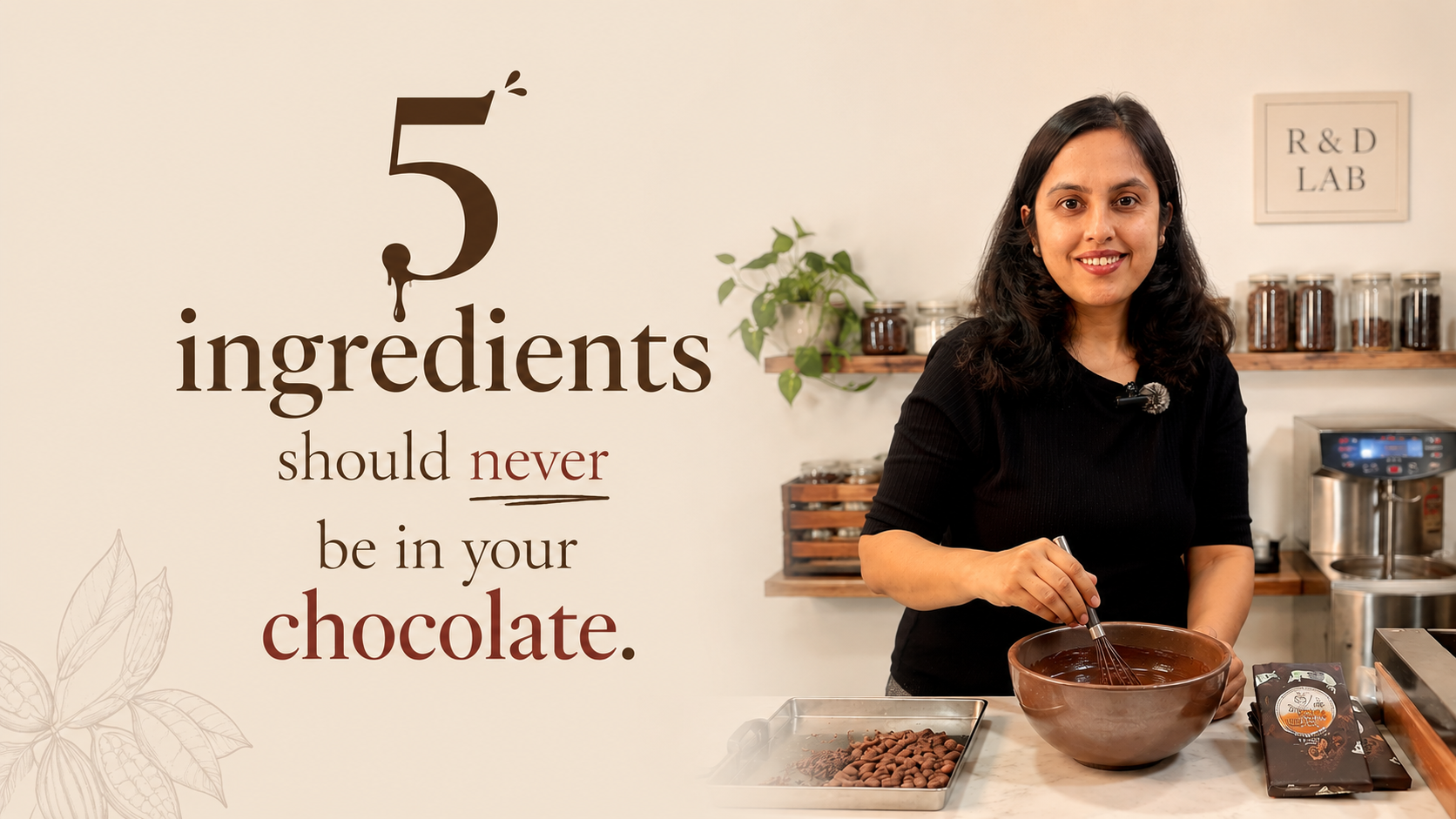
5 Ingredients That Should Never Be in Your Chocolate
Pick up any chocolate bar. Flip it over.
If you can read and understand every ingredient on that label — you're holding real chocolate. If you can't — you're likely holding something the industry calls chocolate, but science tells a different story.
After a decade in chocolate formulation and bean-to-bar production, I've learned to read labels the way a doctor reads a prescription. Here are five ingredients I never want to see in my chocolate — or yours.
1. Vegetable Fat (In Place of Cocoa Butter)
The most common offender in India, and the most important one to know.
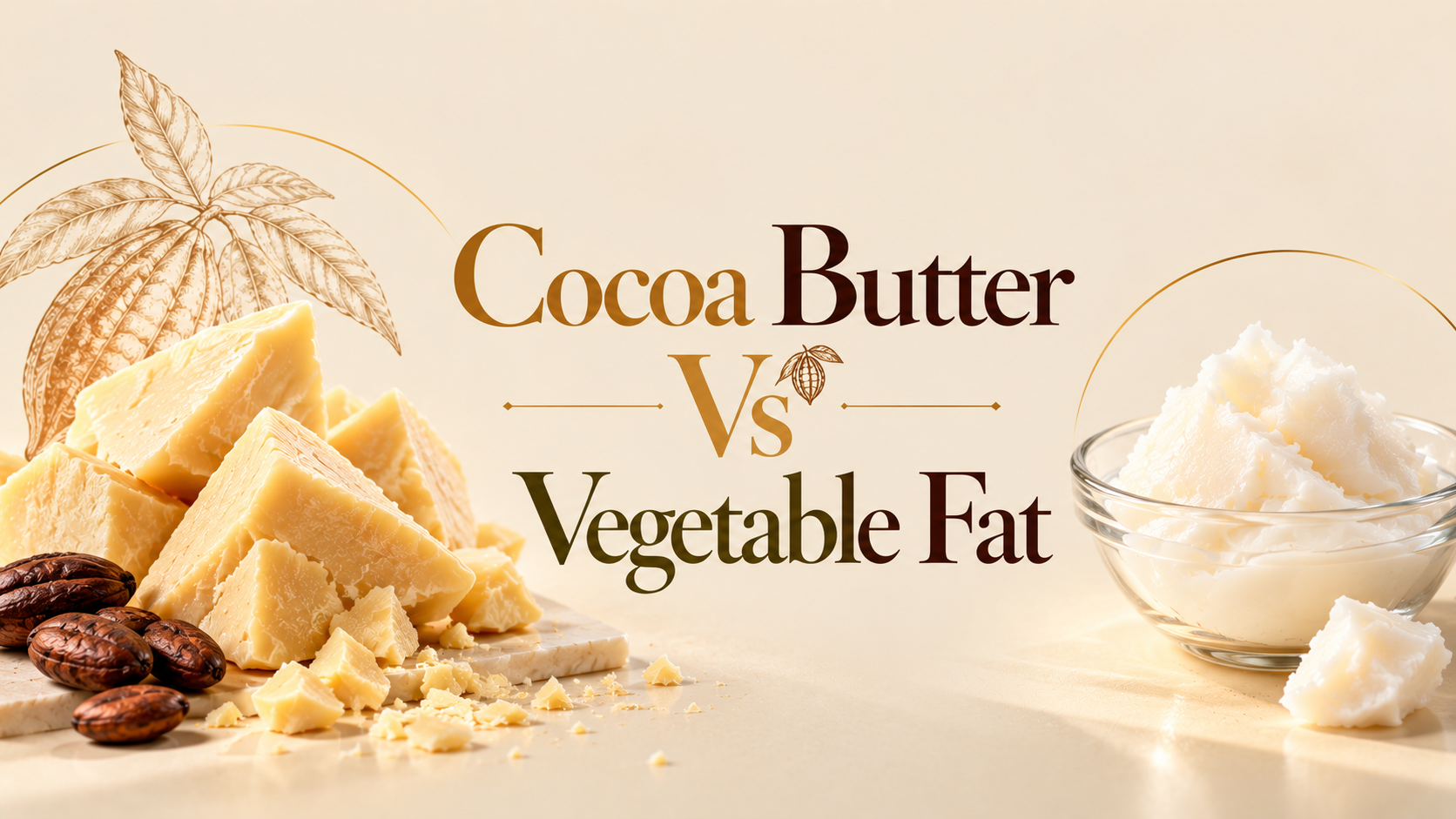
Real chocolate has exactly one fat: cocoa butter — naturally extracted from the cocoa bean. It gives chocolate its signature melt, clean snap, and smooth texture. It's also expensive.
Vegetable fat — palm oil, shea stearin, or hydrogenated vegetable oil — is the cheaper substitute. When brands replace cocoa butter with vegetable fat, the product is technically no longer chocolate. It's compound — a confectionery that mimics chocolate while replacing its most critical ingredient.
Spot it on the label: "vegetable fat," "edible vegetable oil," "palm oil," "hydrogenated fat."
Real chocolate melts on your tongue. Compound coats it. That difference is the fat.
2. PGPR — Polyglycerol Polyricinoleate (E476)
Rarely discussed in Indian food conversations. It should be.
PGPR is a synthetic emulsifier derived from castor oil, used in chocolate to reduce viscosity — which allows manufacturers to use less cocoa butter in the formulation. Less cocoa butter, lower cost. PGPR is the workaround.
Regulatory bodies permit it within limits, so you'll find it in some well-known global brands. But "approved" and "desirable" are not the same thing. Properly made chocolate — with the right cocoa butter ratio and adequate conching — doesn't need PGPR to flow.
Its presence on a label is not a safety issue. It's a quality signal.
Look for E476. In serious artisanal chocolate, you won't find it.
3. Vanillin (Artificial Vanilla Flavouring)
Vanilla and vanillin are not the same ingredient — and this distinction matters specifically in chocolate.
Vanilla extract comes from vanilla beans. Vanillin is a synthetic compound that mimics a single molecule from vanilla's complex flavour profile, produced industrially from wood pulp or petrochemical sources at a fraction of the cost.
Why does this matter? Because vanillin is routinely used to mask the flavour of poor-quality cocoa. Under-fermented, over-roasted, or generally inferior cocoa has off-notes that synthetic vanilla conveniently papers over. You taste warmth and sweetness — not the cocoa underneath, which isn't worth tasting.
High-quality chocolate either uses real vanilla or none at all, because the cocoa stands on its own.
"Artificial vanilla flavouring," "vanillin," or an unspecified "flavouring" — all red flags for what's beneath.
4. Artificial Colours
Real chocolate — from ivory white to 100% dark — gets its colour entirely from its ingredients. No assistance needed.
Artificially coloured chocolates, common in moulded novelties and children's bars, use synthetic dyes like Tartrazine (E102), Allura Red (E129), Sunset Yellow (E110), and Brilliant Blue (E133). These add nothing to flavour, texture, or nutrition.
Several azo dyes have been linked in European regulatory studies to hyperactivity in children — enough for the EU to mandate warning labels on products containing them. India's FSSAI currently requires no such disclosure.
When chocolate needs artificial colour to look appealing, quality couldn't do the job.
5. Multiple Emulsifiers Beyond Soy Lecithin
This one needs nuance.
A small amount of soy lecithin — a natural emulsifier from soybeans — is widely accepted in chocolate production. At 0.1–0.5%, it aids texture consistency and has been standard practice for over a century. No issue there.
The concern is when labels list multiple emulsifiers in combination — lecithin plus PGPR, or lecithin plus polyglycerol esters (E475), or other stacks. Each addition is almost always a signal: lower-grade cocoa butter, insufficient conching, substandard cocoa mass, or aggressive cost reduction.
Well-made chocolate, processed correctly, emulsifies naturally. A long emulsifier list is a formulation workaround — not a quality feature.
The Label Test
Next time you pick up a chocolate, ask five questions:
- Is cocoa butter the fat, or is there a vegetable fat?
- Do you see E476 or PGPR?
- Does it say vanillin or unspecified "flavouring"?
- Are there colour codes — E102, E110, E129?
- Are there more than two emulsifiers listed?
If any answer is yes — you know what you're holding. And you can choose accordingly.
Real chocolate has a short ingredient list: cocoa mass, cocoa butter, sugar, and perhaps milk solids and real vanilla. Everything beyond that deserves a question.
The goal isn't to make chocolate complicated. The goal is to make it honest.

Leave a comment
Share your thoughts, questions, or experience with this chocolate science topic.