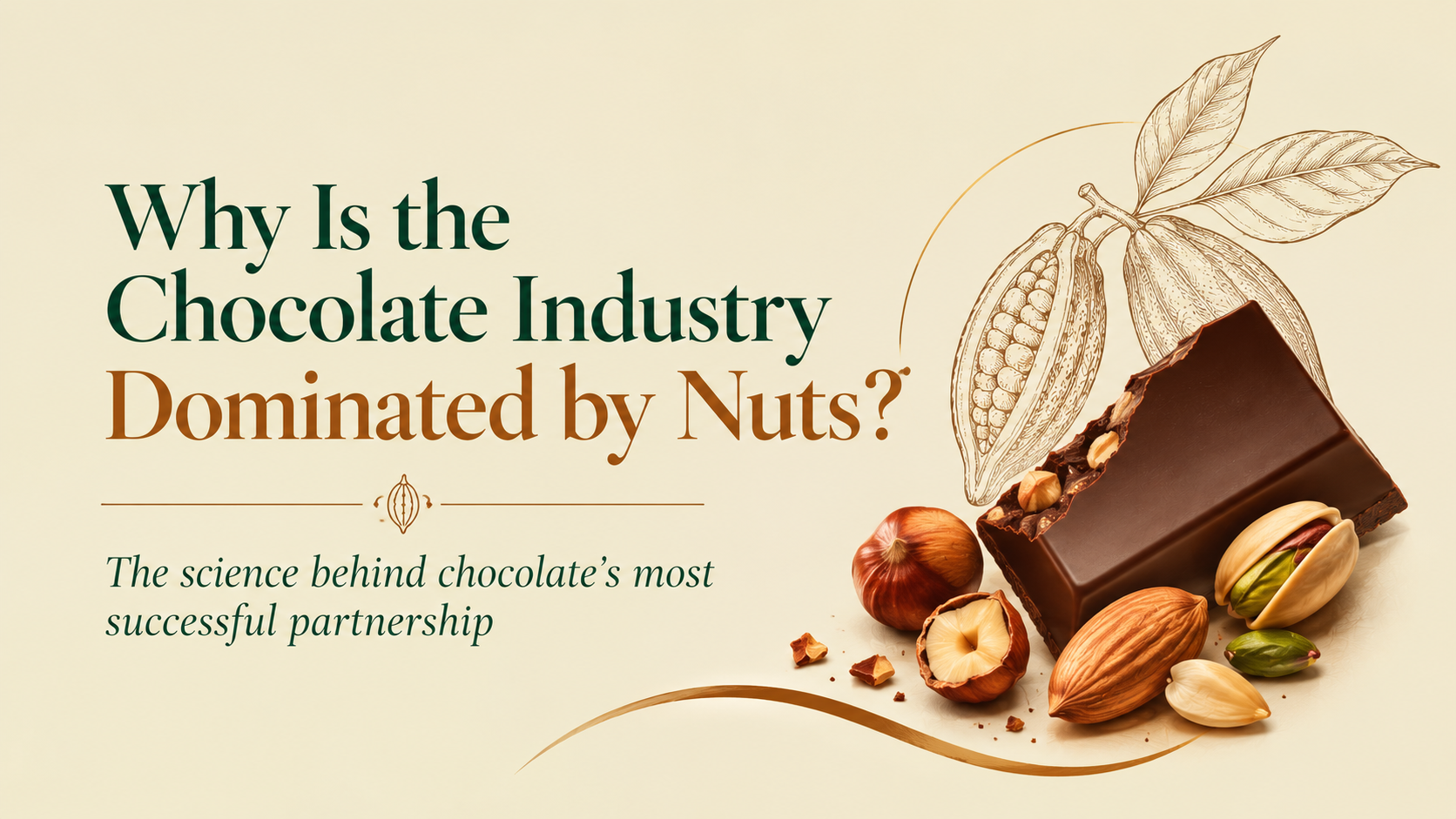
Why Is the Chocolate Industry Dominated by Nuts?
Walk into any supermarket, chocolate boutique or airport duty-free store anywhere in the world, and you'll notice one thing almost immediately. Nuts are everywhere. Hazelnuts. Almonds. Pistachios. Peanuts. Cashews. Macadamias. They're inside bars, pralines, spreads, truffles, dragées and premium gifting boxes.
Have you ever wondered why? With thousands of ingredients available to product developers, why has the chocolate industry continued to rely on nuts for more than a hundred years?
The answer has surprisingly little to do with tradition. It has everything to do with science.
Chocolate Doesn't Need More Flavour. It Needs the Right Flavour.
Chocolate is already one of the most flavour-complex foods on Earth. Depending on its origin and roasting profile, cocoa can develop notes of caramel, coffee, honey, berries, flowers, wood and even dried fruits. Adding another ingredient can easily disturb this delicate balance.
Nuts are one of the very few ingredients that don't compete with chocolate — they strengthen it. That's why chocolate still remains the hero, even in a hazelnut chocolate bar.
The Secret Lies in Roasting
This is where things become fascinating. When cocoa beans are roasted, hundreds of aroma compounds are formed through the Maillard reaction. Exactly the same thing happens when you roast almonds or hazelnuts.
Both ingredients begin producing similar families of flavour molecules — particularly pyrazines, furans and Strecker aldehydes — which are responsible for roasted, caramelised and cocoa-like aromas. This is why roasted hazelnuts naturally feel as though they belong inside chocolate. They're speaking the same flavour language.
Chocolate Is a Fat System — and Nuts Fit Perfectly
Many people think chocolate is mostly cocoa and sugar. From an R&D perspective, that's only half the story. Chocolate is actually a carefully engineered fat-based suspension, where cocoa butter forms the continuous phase. Any ingredient added to chocolate must behave well inside this fat network.
Nuts do exactly that. With an oil content ranging from 45% to over 75%, they blend naturally into chocolate without introducing moisture — something fruits and many other inclusions constantly struggle with.
Fat understands fat. That's one of the biggest reasons nuts perform so beautifully in chocolate.
Crunch Is More Important Than We Think
Consumers often say they love nut chocolates because they're crunchy. They're right — but not for the reason they think. Texture creates excitement.
Plain chocolate gives you two sensations: snap and melt. Add a roasted almond or hazelnut, and suddenly every bite becomes dynamic. First comes the clean snap of tempered chocolate. Then the crisp fracture of the nut. Finally, the gradual release of roasted oils and aromas.
That changing texture keeps the brain engaged. It's one of the reasons nut chocolates feel far more satisfying than plain chocolate.
Roasting Creates an Entirely New Ingredient
A raw hazelnut and a roasted hazelnut may come from the same tree, but inside a chocolate factory they're almost treated as two different ingredients. Roasting reduces moisture, increases crunch, develops sweetness and unlocks hundreds of new aroma compounds.
That's why premium manufacturers spend enormous effort perfecting roasting profiles. Just as cocoa roasting defines the personality of chocolate, nut roasting often defines the personality of the product.
Nuts Quietly Improve Chocolate
One of the least discussed advantages of nuts is that they improve chocolate without consumers even realising it. Their roasted flavour softens bitterness. Their buttery notes round off sharp edges. Their oils improve flavour release.
Even visually, whole nuts instantly create the impression of generosity and craftsmanship. Before taking the first bite, the brain has already decided: "This looks premium."
Why R&D Teams Love Nuts
From a product development perspective, nuts are incredibly versatile. The same ingredient can be used whole, chopped, sliced, caramelised, coated, converted into praline, refined into gianduja or processed into smooth nut butter. Few ingredients offer this level of flexibility while remaining compatible with moulding, enrobing, panning, fillings and spreads.
Of course, nuts aren't without challenges. Oil migration, oxidation and moisture control require careful attention. But compared to many other inclusions, they remain one of the most reliable ingredients a chocolate technologist can work with.
Can Anything Replace Nuts?
The industry has experimented with freeze-dried fruits, cookies, cereals, seeds, spices and countless innovative inclusions. Many are excellent. None have matched the complete package that nuts offer.
Because nuts don't excel in just one area. They perform brilliantly in flavour, texture, processing, visual appeal, consumer acceptance and premium perception — all at the same time. That's an exceptionally rare combination.
Final Thoughts
Chocolate and nuts weren't designed for each other. Nature simply gave them remarkably compatible chemistry. One contributes complexity, smoothness and melt. The other contributes crunch, roasted aroma, richness and visual appeal.
Together, they create an eating experience that has stood the test of time. Perhaps that's why, after more than a century of innovation, the chocolate industry still keeps returning to the same trusted ingredient.
Not because it's traditional. Because very few ingredients understand chocolate as naturally as a perfectly roasted nut.


Leave a comment
Share your thoughts, questions, or experience with this chocolate science topic.