
What Really Happens When Milk Fat Enters Chocolate?
Two fats walk into a bar of chocolate. Why milk chocolate behaves so differently from dark, and what is actually happening at the molecular level.
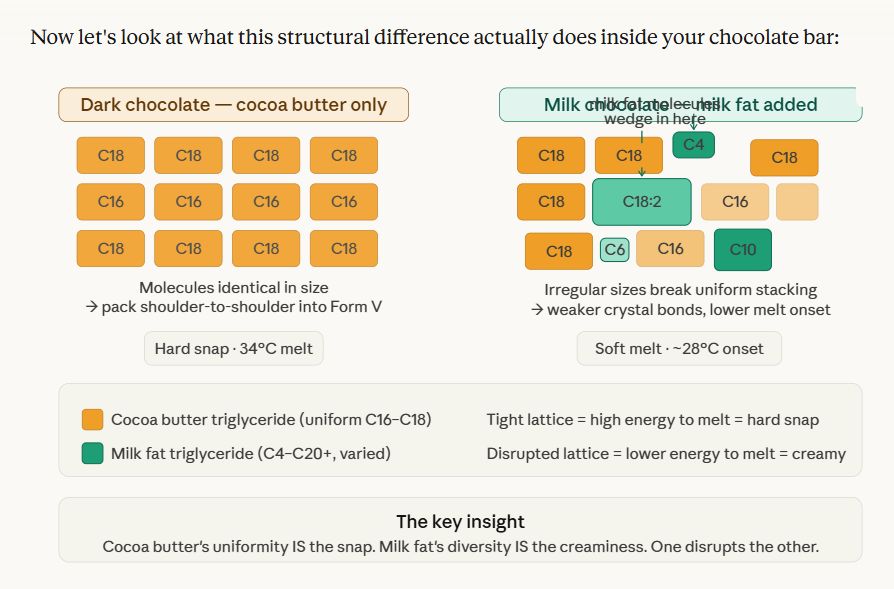
Dark chocolate is built on cocoa butter, a remarkably well-organized fat. Three triglycerides, POP, POS, and SOS, dominate its structure and give it that sharp snap and clean 37C melt. Highly symmetrical. Highly predictable.
Milk fat is the opposite. It contains more than 400 different fatty acids across short-chain, medium, and long-chain structures, both saturated and unsaturated. Chaotic by design.
The Six Forms Problem
Cocoa butter crystallizes into six distinct polymorphs, Forms I to VI. Only Form V gives you the gloss, snap, and melt you want. Everything else is a problem.
When milk fat enters the picture, its irregular molecules insert into the cocoa butter crystal lattice. That reduces packing efficiency and slows down Form V formation. The result is softer, less brittle, creamier chocolate.
Tempering Tip
Lower your seed temperature by 1 to 2C for milk chocolate versus dark. In practice that means around 27 to 28C instead of 28 to 29C.
Why It Matters for Snap
Milk fat interferes with Form V crystal formation, so it needs a slightly cooler environment to cooperate. That is one reason milk chocolate feels softer and less snappy than dark.
The Eutectic Effect
Here is the counterintuitive part: mixing two fats can produce a blend that melts at a lower temperature than either fat alone. Milk fat and cocoa butter form a partial eutectic system, which is a major reason milk chocolate melts so readily on the tongue.
The Hidden Bonus: Phospholipids
Milk fat also brings phospholipids such as phosphatidylcholine and phosphatidylinositol. These amphiphilic molecules naturally coat sugar crystals and cocoa particles in the melt, acting like built-in emulsifiers.
The practical effect is better particle dispersion and a smoother texture, even before lecithin is added. In other words, milk fat can do part of your emulsifier's job for free.
What This Means for Flavor
Fat carries aroma compounds. Because milk fat is more complex, it offers more opportunity for flavor binding. It softens cocoa bitterness, rounds acidity, and contributes its own notes, especially buttery and creamy lactones.
The result is not just a texture change. It is a perception change.

Leave a comment
Share your thoughts, questions, or experience with this chocolate science topic.