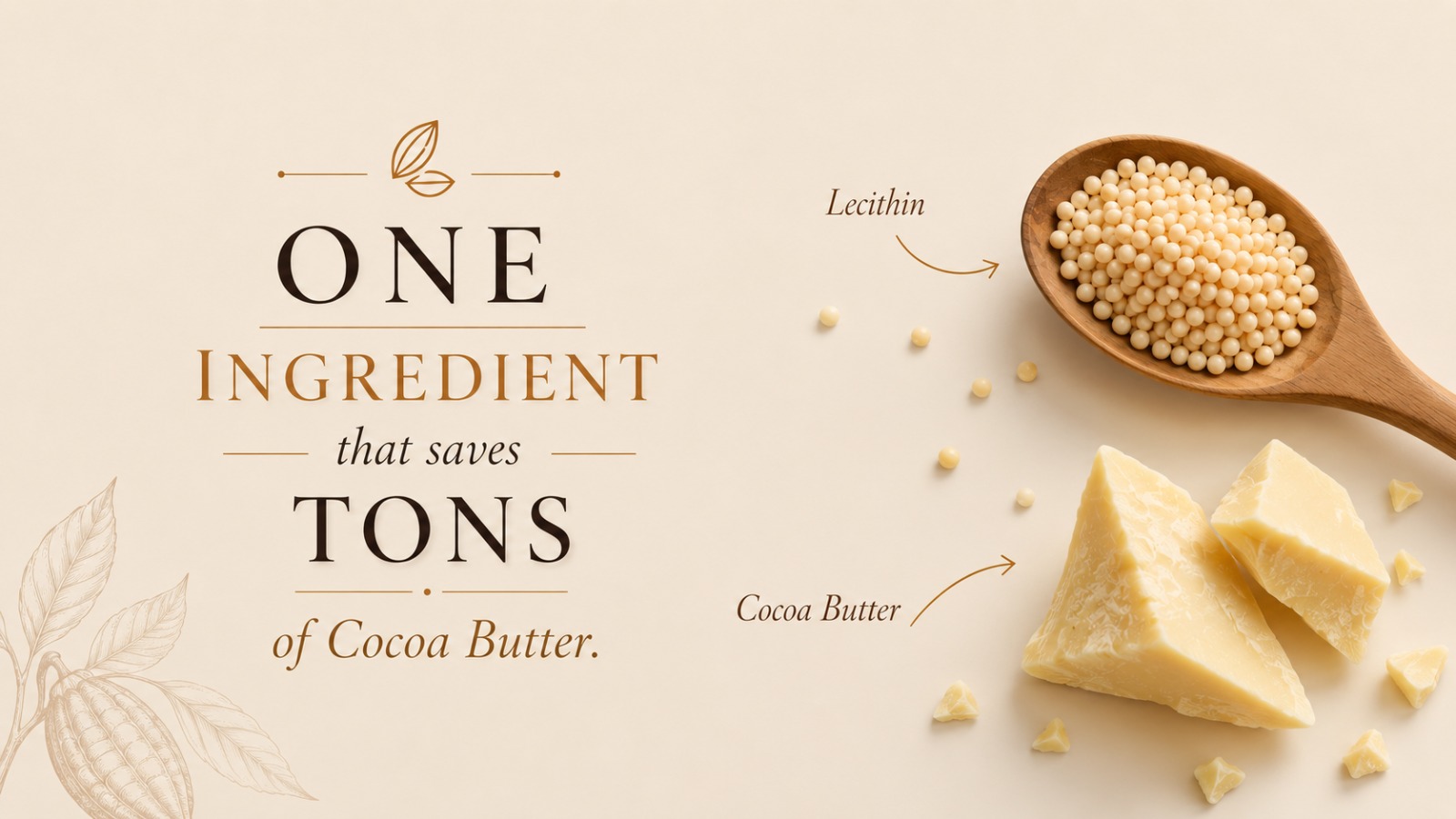
Open any chocolate wrapper and flip it over. Somewhere in that ingredients list, you will spot it — soya lecithin or simply lecithin. It sits there quietly, used in tiny amounts, and most people scroll right past it. But without it, making chocolate at scale would be a completely different story.
"Lecithin does not change how chocolate tastes. It changes how chocolate behaves — and that changes everything."
What exactly is lecithin?
Lecithin is a naturally occurring fat-like substance called a phospholipid. Do not let the science word scare you. Think of it as a molecule that has two personalities — one side loves water, the other loves fat. This dual nature makes it an outstanding emulsifier: it gets along with both water-based and fat-based ingredients, helping them mix smoothly instead of separating.
In the food world, lecithin is most commonly extracted from soy. You will also find it from sunflower seeds (preferred in allergen-free or non-GMO products) and, classically, from egg yolks.
Soy lecithin (most common) Sunflower lecithin (allergen-free) ** Egg yolk (traditional)
Why does chocolate need an emulsifier at all?
Chocolate is essentially a mixture of cocoa solids, cocoa butter, sugar, and milk solids (in milk chocolate). The problem? Cocoa solids and sugar carry tiny amounts of moisture — and moisture and fat (cocoa butter) do not like each other.
When you are manufacturing chocolate and melting it down to pour into moulds, the batter — called chocolate mass — can become thick, sticky, and difficult to work with. This stickiness is measured as viscosity. High viscosity means the chocolate resists flowing. It clogs pipes, it does not coat evenly, and it takes more energy (and more cocoa butter, which is expensive) to keep it fluid.
Enter lecithin.
What lecithin actually does in chocolate
Lecithin molecules position themselves at the boundary between the tiny sugar and cocoa particles and the surrounding cocoa butter. They coat these particles, reducing friction between them. The result: the same chocolate flows more easily without adding more fat.
** Primary role Reduces viscosity Makes the chocolate mass more fluid at the same fat content — critical for enrobing and moulding.
** Economic benefit Replaces cocoa butter Adding 0.3–0.5% lecithin can replace 3–5% extra cocoa butter — a significant cost saving.
** Process control Improves workability Helps chocolate flow through machines consistently, reducing defects in the final product.
How much is actually used?
Very little. Lecithin is effective at levels as low as 0.3% to 0.5% of the total chocolate mass. Interestingly, more is not always better — beyond 0.5%, additional lecithin can actually start to increase viscosity again, working against its own purpose. Chocolatiers and manufacturers need to get this dosage right.
Technical quick reference Typical usage level0.3% – 0.5% of chocolate mass Effect beyond 0.5%Viscosity increases (counterproductive) Cocoa butter it replaces~3–5% per 0.5% lecithin added Taste impactNeutral — does not alter flavour Regulatory max (most regions)1% of finished product
Does it affect taste or texture?
At the levels used in chocolate, lecithin is flavour-neutral. You will not taste it. What you do notice — without knowing why — is the smoothness of a well-made bar. That easy melt, that silky coating on your tongue, is partly lecithin's contribution to how uniformly the chocolate was processed.
However, bean-to-bar craft chocolate makers sometimes choose to skip lecithin entirely. They prefer to rely on longer conching (the process of continuously agitating melted chocolate for hours) to develop smoothness and fluidity naturally. This is a deliberate philosophical choice — not a technical necessity.
Lecithin vs. PGPR — the controversy
In the early 2000s, some large manufacturers switched partially from lecithin to a synthetic emulsifier called PGPR (polyglycerol polyricinoleate). PGPR is even more powerful at reducing viscosity — specifically the yield value, meaning it makes chocolate start flowing with less force applied.
The controversy? PGPR is used to cut cocoa butter costs further, and critics argued it changed the mouthfeel of some mass-market chocolates — making them feel slightly waxy or less rich. PGPR remains legal and widely used, but premium and craft manufacturers tend to stick with lecithin as the more trusted option.
Is it safe? What about soy allergies?
Lecithin is recognised as safe by food regulatory bodies worldwide. Soy lecithin is highly refined, and during extraction, the soy proteins that trigger allergies are almost entirely removed. Most allergists consider soy lecithin safe even for soy-sensitive individuals — but anyone with severe soy allergies should consult their doctor. If you want to avoid soy entirely, look for sunflower lecithin on the label — it performs similarly and comes with no allergen concerns.
"Craft makers who skip lecithin are not making better chocolate. They are making a different choice — and both choices can lead to exceptional results."
The craft chocolate perspective
Many artisan bean-to-bar makers wear the absence of lecithin as a badge of purity. It is a fair claim — using extended conching and carefully sourced cocoa butter to achieve fluidity naturally is a more labour-intensive process. But it is worth understanding that lecithin's absence does not automatically make a bar superior. The quality of the cacao, the fermentation, the roast profile — these matter far more to the flavour in your cup than whether the maker used 0.4% soy lecithin.
What lecithin does is make the craft of chocolate manufacturing more consistent, more accessible, and more economical — which is why it has earned its place in almost every commercial chocolate bar on the planet.
Next time you eat a chocolate bar, you now know a little more about the invisible hand that made it smooth. That is what chocolate education is for.

Leave a comment
Share your thoughts, questions, or experience with this chocolate science topic.