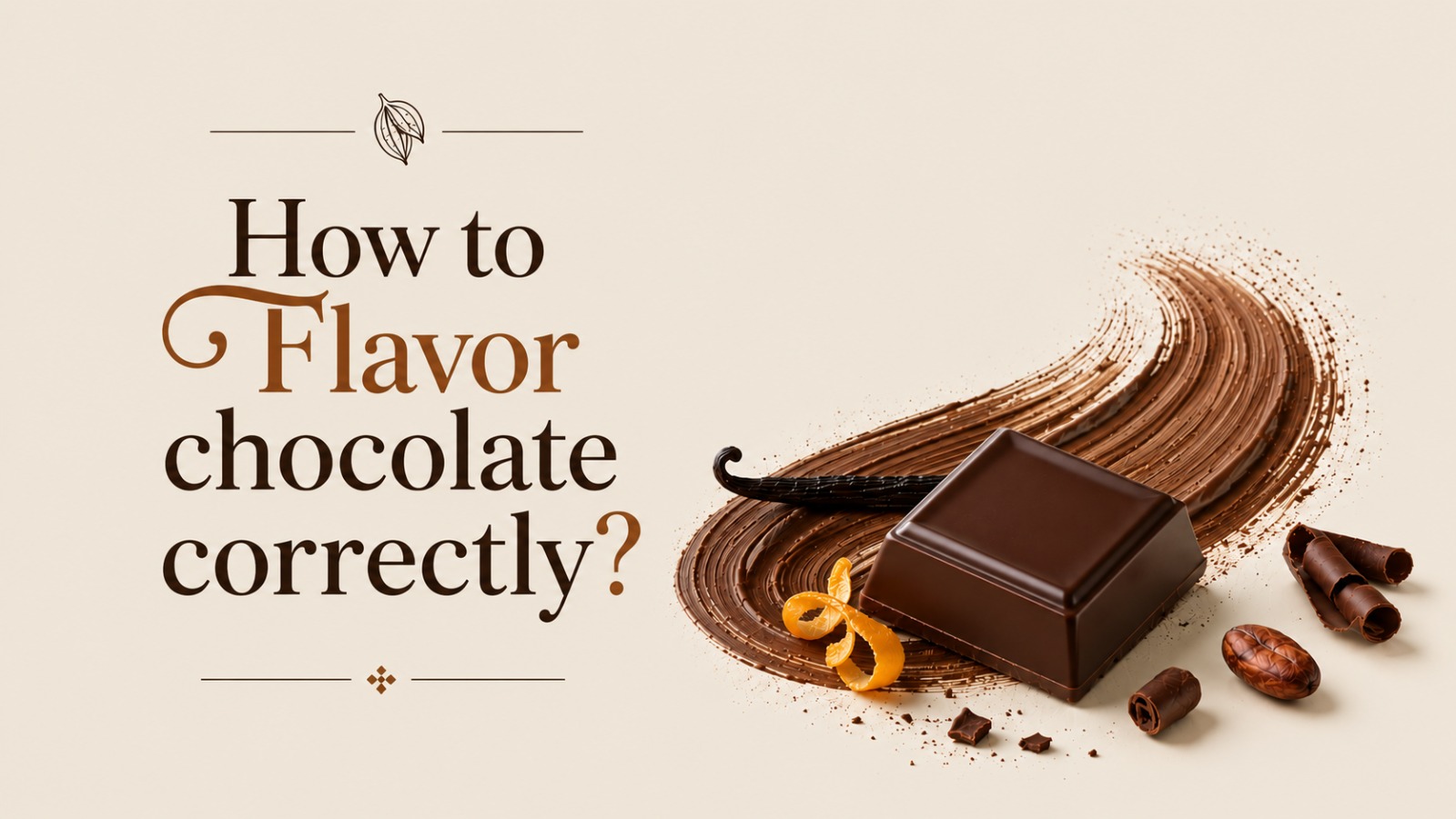
Chocolate is an unforgiving matrix. Add the wrong type of flavor, at the wrong moment, in the wrong amount, and it either disappears or ruins the batch. Here is what you need to know to get it right every time.
1. Always Use Oil-Based Flavors
Chocolate is a fat-continuous system. Oil-based flavors dissolve directly into cocoa butter and disperse cleanly throughout the mass. Water-based or alcohol-based flavors do the opposite: they can seize the chocolate, spike viscosity, and increase bloom risk in the finished product.
The rule is simple: if the flavor carrier is water, propylene glycol, or ethanol, it does not belong in chocolate. Use oil-soluble essential oils, oleoresins, or flavors dissolved in a food-grade triglyceride carrier.
2. Add at the Right Temperature
The best window for adding oil-based flavors is post-conching, before tempering, when the chocolate mass is fluid at around 45 to 50C and no longer under aeration. At this stage, the fat is fully mobile, mixing gives even distribution, and volatile loss stays relatively low.
Adding flavor during conching strips many top notes before they ever reach the consumer. Adding during or after tempering risks uneven dispersion as the chocolate thickens.
3. Get the Dosage Right
Oil-based flavors are concentrated. Most essential oils and flavor compounds work in chocolate at roughly 0.1% to 0.5% by weight of the finished mass. Start low, taste in the actual chocolate matrix, and adjust.
Dark chocolate can usually carry higher loadings than milk or white chocolate because of its stronger cocoa base. Over-dosing often produces sharpness and chemical off-notes that cannot be corrected later.
4. Mix Thoroughly: Dispersion Is Everything
Even a compatible oil-based flavor will create hot spots if mixing is inadequate. Add the flavor while the chocolate is still fluid and allow enough agitation time before tempering. Thick oleoresins should be pre-diluted in a small amount of warm cocoa butter or carrier oil before addition.
This helps the flavor enter as a fine, easily dispersible liquid rather than a dense droplet that resists even distribution.
5. Watch Oxidative Stability
Once dispersed in the fat phase, your flavor is exposed to the same oxidative conditions as the cocoa butter. Citrus flavors, especially those high in limonene and other terpenes, are particularly vulnerable and can oxidize into cardboard or turpentine-like off-notes within shelf life.
Use deterpenated or folded citrus oils for better stability. For any flavor-forward product targeting a 6 to 12 month shelf life, run accelerated shelf-life validation before launch, not after a consumer complaint.
Common Mistakes to Avoid
- Do not use water-based flavor concentrates. Even a small amount of free water can cause irreversible textural damage.
- Do not add flavor during conching. High temperature and continuous aeration will volatilize much of the flavor before conching ends.
- Do not taste in carrier oil instead of chocolate. Flavor perception in cocoa butter at body temperature is different, so validate in the final matrix.
- Do not skip shelf-life validation. A flavor that smells perfect on day one can become rancid or chemical by week eight if stability has not been tested.
The Bottom Line
Use oil-based flavors. Add them at the right moment. Disperse them properly. Validate the shelf life. That is the whole game.


Leave a comment
Share your thoughts, questions, or experience with this chocolate science topic.